Exhibition Statement
Welcome to the audio-described tour of Core Concerns, Care Embodiments, an exhibition presented at The McMullen Gallery.
There are 9 artists and 11 artworks in this exhibition. For each artwork, the audio description track begins with a visual description. Then, I talk about the meaning of the work and provide information about the artist.
This audio tour begins with the exhibition statement, which is printed on a large white banner to the right of the gallery entrance.
The exhibition is titled Core Concerns, Care Embodiments, and it is open from October 5th to October 25th, 2026.
It includes artworks by Dylan Brenneis, Calli Giroux, Michelle Kwasnycia, Brooke Leifso and Mona Sahi, Monique Mah, Samantha McLeish, Aynaz Raoufian, Sheryl Spencer, and Al Young. It is curated by Ginger Carlson.
Core Concerns, Care Embodiments is the first public presentation of artistic work created in connection with Co-designing a Smartwear Revolution, an interdisciplinary research project led by the University of Alberta, developing “smart” garments that can respond to the body and provide support when needed. The exhibition features new work by current students and graduates from the University of Alberta Department of Art and Design.
From the intimate to the systemic and the relational to the responsive, the artworks in Core Concerns, Care Embodiments tend to the complexities, multiplicities, and potential choreographies of bodies, assistive technologies, and care networks. Together, they take up the poetics of one of the project’s core scientific and technical research concerns: what can (trunk) support do?
The exhibition has an opening event on October 9th, from 6:00 p.m. to 9:00 p.m. with a quiet, masked opening event from 5:00 p.m. to 6:00 p.m.
We will also present an Art & Science panel discussion on October 16th from 3:00pm to 5:00 p.m. and a Smartwear prototype shirt demonstration on October 23rd from 3:00pm to 5:00 p.m.
On the next track, I read a small, blue panel with information about Co-designing a Smartwear Revolution. This panel is located around the corner to your left, just past the reception desk.
About Co-designing a Smartwear Revolution
Co-designing a Smartwear Revolution is a large, six-year research project led by researchers at the University of Alberta and funded by the Government of Canada’s New Frontiers in Research Fund. The project involves the co-design of smart clothing that will look like regular clothing, but will have technology embedded in the fabric that can easily support posture, balance, arm movements, and walking. This project aims to create accessible, affordable, functional and stylish “smartwear” to support movement, prevent workplace injuries, and improve quality of life for people with neuro-muscular and skeletal weakness, older adults, and health care professionals, including nurses.
The Smartwear Revolution project includes opportunities for artists, performers, and fashion designers to respond creatively to the development of smartwear. These opportunities include an artist-in-residence program and a series of open calls for exhibitions, live performances, dress events, and community engagement initiatives. We are currently accepting expressions of interest from artists, designers and performers who would like to submit proposals for an art & technology festival in Spring 2028 on the theme of SUPPORT.
More information about the technical aspects of the project, how Smartwear Revolution invites participation and co-design from people with lived experience of muscle weakness, as well as information about our artist opportunities can be found on the project website smartwearrevolution.com.
On the next track, I describe an artwork located just to the right of this panel.
Al Young: Our Future is Built Together
Our Future is Built Together is a small paper zine. It was created by Al Young in 2026. Several copies of the zine are placed on a small wood shelf mounted to the wall. Visitors are invited to read the zine in the gallery or take one home. A screen reader friendly PDF of the zine can be found on this webpage.
The zine is a bit bigger than a large postcard, approximately 8 by 5 inches. Its front and back cover feature a photograph of Al’s blue leather sketchbook, its corners worn and with pieces of paper sticking out. An image of a yellow sticky note taped to the sketchbook’s cover reads, “Sketching Collaboration” and “Lessons from Smartwear.”
Inside the zine, drawings of people and technologies collide with sketches, photos of Al’s artworks, and both handwritten and printed text. Sections are emphasized by colour blocks, many in shades of yellows and blues. Al uses the visual language of collage to layer images and sections of text as if they were torn or cut out of magazines and then glued or taped together.
The zine’s text reflects on Al’s experiences as a caregiver, artist, and summer 2026 practicum student with Smartwear. Some of the zine sections include, “a peek inside the labs,” “how I drew a battery system,” “who’s taking care of the caregivers?” and “how can we encourage more collaboration going forward?”
About the artwork and artist:
Our Future is Built Together considers some of the key questions that emerged for the artist during their practicum. What innovations are possible when more people with lived experience actively participate in constructing assistive technology? How do we build solidarity beyond research? As both a caregiver and a disabled person, these questions hold a deep personal resonance for Al. By creating this zine, they hope to extend some potential answers through the sharing of their experiences and reflections.
Al Young is a multimedia artist. Their work is informed by their experiences with queerness, disability, and community organizing. Their practice encourages audiences to question social conventions of the body and imagine new ways of caring for each other.
The next artwork in the exhibition is on the wall adjacent to this one, to your right.
Brooke Leifso and Mona Sahi: A body among bodies
A body among bodies is a captioned video artwork created by Brooke Leifso and Mona Sahi in 2026. The video is 5 minutes and 20 seconds long.
The video is playing in a continuous loop on a black television mounted to the wall. There is a soft, grey bench positioned parallel to the wall, approximately 1.5 metres away. Below the television are two headsets for listening to the artwork’s audio. A white brochure holder is mounted to the left of the television. It holds a free, paper leaflet detailing Edmonton and Alberta-based organizations and resources aimed at protecting disability and social supports, and connecting those who are impacted by them. A screen reader friendly PDF of the leaflet can be found on this webpage.
The video begins with the two artists in profile against a white background. The frame is cropped at chest height and both artists wear black. Brooke is a white settler Canadian woman in her thirties with light brown shoulder length hair half pulled back. She is in the foreground and is turned to face the right. Mona is behind her and facing left. Mona is an Iranian woman in her thirties with curly salt and pepper hair pulled back into a bun. Brooke’s shadow falls in front of her, to the right, casting the echoed shape of her profile onto the white background.
The artists hold their positions in profile throughout the video. After about a minute and half has passed, when Mona begins to count, the image blurs and flips so that Brooke is facing left, and Mona, to the right. When Brooke begins speaking again, the image returns to its previous composition and clarity. Every time the artists are counting, the image blurs, and at the end, it flips, showing them upside down. At 4 minutes and 45 seconds, the artists slow their voices as the image fades to black.
About the artwork and artists:
A body among bodies explores the current state of disability support within an individual and community. With an emphasis on care and reflection rather than resolution, the work questions our shared responsibility in shaping a society that is thoughtful, inclusive, and accountable to individuals with different abilities and forms of embodiment. Crucially, the video engages the social model of disability, which emphasizes how disability is produced by environments, attitudes, and societal barriers rather than being located within a body.
Mona Sahi is an Iranian multidisciplinary artist working across interactive sculpture, installation, performance, sound, and video. Mona’s artwork is grounded in activism, resistance, and a deep commitment to social justice.
Brooke Leifso is a Disabled/Crip performance artist and producer, Expressive Art Practitioner, access consultant, and academic. She has made artwork with youth, disability communities, communities in conflict, as well as through collective creation and as a solo performance and theatre artist.
To find the next artwork, follow this wall to your right past a pillar and a chair where a large sculpture is placed about a foot in front of the wall.
Dylan Brenneis: Development As Dance
Development As Dance is an art installation created by Dylan Brenneis in 2026. It is composed of a large tree limb with three branches connected to various electronic elements, including a motion sensing device and motor.
The slender limb of a tree with three branches is displayed vertically, its base secured to the centre of a tapered plinth. The plinth is a six-sided, geometric frame with navy blue cotton fabric stretched over it. The tree limb is mounted upright by its thickest end, which is about the size of a wrist. And a tall black metal pole is mounted behind the tree limb. Three protruding metal rods near the top of the pole provide structural support for the tree branches through three hanging bungee cords which connect to the ends of each branch.
The tree limb is from a Maple tree. Its bark has been stripped off, leaving it pale and smooth, glistening as if polished with oil. The branches are mostly bare, retaining only a few delicate twigs. Each branch features a section where the artist has created a joint by cutting the branch in two and then reattaching them together with flexible wire and copper mesh. These wounds are emphasized on either end by strips of the cotton blue fabric, fastened with oblong wood buttons.
One long blue fabric tube winds from the base of the sculpture up the metal pole and all the way up to the ceiling. It powers a motion sensing device placed directly above a blue sticker on the floor, located approximately three feet in front of the sculpture. This six-sided sticker is about three feet wide by three feet in length. And it features a white graphic of the tree limb in its centre, framed by two blue arrows pointing outwards, one to the tree limb’s left and the other to its right.
This sticker communicates where a visitor can place their body if they want to interact with the sculpture. Sway from side to side and the tree limb shifts left and then right from its base, its branches bending at their joints, twigs jiggling. Sometimes the sculpture’s movements are quick or responsive, and at others, hesitant or delayed. A small movement of the head or arm may translate once, intermittently, or not at all. At times, the tree branches’ shuddering may continue long after you exit the motion sensor’s range.
About the artwork and artist:
Development As Dance explores the development of assistive technology as a series of creative encounters between the people who use it, the people who produce it, and the technology itself. As partners within a dance of development, their movements might be composed or conversational, interpretive or choreographed, synchronized or out of step.
Visitors can enter into this dance by placing their body in front of a sculpture and making the first move. Using motion sensing technology, the sculpture will respond in kind, as it attempts to understand and translate a visitor’s gestures.
Lag, misinterpretations, and the slow accumulation of drift may lead to some disharmony between dance partners. In this way, the work tends to both the hopeful intentions of developing and using assistive technologies as well as their potential challenges and limitations.
Dylan Brenneis is an interdisciplinary artist with a research-creation practice that explores relationships between humans and the machines they create. Through machine building, Dylan’s artworks explore the negotiation and blurring of the human-machine boundary. His work draws on experiences as a Senior Research Engineer at Google DeepMind and with developing internationally adopted open-source robots for prosthesis control research at the BLINC Lab.
The next artwork is also on this wall, to the right of the sculpture.
Calli Giroux: Dragging My Feet to Love and Hate
Silkscreen prints are created by sequentially layering different colours of ink, which combine to create a single multi-coloured image. Calli used 5 ink colours to create this work, beginning with an atmospheric, feathered field of mustard yellow ink, which forms the rectangular background of the image. A mossy green ink encloses a flat plane of yellow in a curving horizontal rectangle in the centre. Inside, black inked text is printed in a non-serif bold font. It reads: “mediPUMP, THE BEST REUSABLE INSULIN PUMP” and in larger text, “AUTOMATIC INSULIN DEVICE.” Then, below and in smaller text: “CONTENTS: ONE – Automatic Insulin-delivering device, ONE – brief on constantly monitoring your device and how to recognize auditory hallucinations.” The next text section is bracketed by a small star or asterisk on either side. It reads, “pump instructions will be learnt over time.”
The same green ink that frames this section of text is also used to create a vertical rectangle with two curved edges that covers the left hand fourth of the image. On the right-hand side of the print are three overlapping abstract shapes inked in blue, red, and orange. They are rectangular in shape with a curved tube emerging from their top edges.
Along the top and bottom of the print are sections of text printed in black ink. In some areas these sections of text are scribbled over and accompanied by commentary in blue ink or emphasized with red ink. While the black text appears uniform, as if printed on a label, the interventions and adaptations in blue and red ink are scrawled, as if written by hand. I will now read this text beginning in the top left corner.
Printed in black ink, the text reads “ONE MADE IN U.S.A 1963.” Blue ink scratches out “IN U.S.A” and adds some scrawled text below it. It amends the text to read, “ONE MADE By an IDIOT! 1963.”
Next, centred along the top of the image in black capital letters is “ULTRAMED DEVICES INC.” In red ink, pointed devil’s horns and a curving tail ending in an arrow frame the word, “ULTRAMED.” To its right, and in quotations, black text reads, “Were With You For Life!” “Were” is spelled w-e-r-e here, not as the contraction for we are, but in its past tense, as in, “we were with you for life.” And in the far, right top corner, a letter and number combination of “NO. DD-07.”
In the bottom left corner, a disclaimer in black ink reads, “DISCLAIMER: this is NOT a cure for diabetes, don’t get your hopes up.” This disclaimer is accompanied by a blue inked scrawl just above it that says, “This thing fucking SUCKS!”
To the right of this text, from the bottom of the print in its centre to the far, right edge a large block of black inked text reads:
“WARNING: The mediPUMP Insulin Device may cause changes that Ultramed Devices Inc. is not responsible for, symptoms vary between users. These include but are not limited to, depression, anxiety, frustration, hatred, a sense of impending doom, dread, aggression towards others, sleep deprivation, negative thoughts, increased resentful obligation, impatience, intolerance, and an indescribable feeling only you will know. Consider medical attention if you do not experience any of the following symptoms.”
Monique Mah: 27+6
27+6 is a soft sculpture created by Monique Mah in 2026. The sculpture consists of reclaimed textile curtains and a body form made from foam and white cotton muslin.
Sheer gauzy light pink fabric the colour of cotton candy is draped over a bust and torso. The sculpture sits on a light pink plinth, which is mostly covered by long, draped folds of fabric. This fabric features areas that are gathered and held in place to create swooping curves and areas of geometric texture and depth. The gathers begin around the neck and end just below the midsection, such that the rest of the fabric drapes in long folds nearly to the floor.
Fabric gathered along the chest creates a loose zig zagging pattern that continues downward along the sides of the body. Here, deep folds create long graceful curves that are pinched and folded together at the hips. The middle of the stomach is nearly smooth, with only one area of gathered tension where the fabric is pinched inwards directly in its centre. A few inches to the left and right if this centre pinch and the gathers begin again, manipulating the fabric into triangular folds that point and pull outwards, away from the body. These folds stack up on top of each other, to create two mountainous cascades of fabric on either side of the stomach.
The back of the garment features an entirely different landscape of folds. Here the fabric is pinched vertically, creating long lines of parallel geometric folds that run the length of the spinal cord and to either side, covering the back entirely. These sections almost look like the fabric has been braided with tighter folds closer to the hips. The folds on this side of the garment taper to a point at their bottom edge before gently cascading the remaining fabric to the floor.
About the artwork and artist:
27+6 is a soft sculpture that draws on the artist’s embodied experience of her first pregnancy. The artwork explores how shifts in tension, resilience, and the structure of textiles may parallel the shifting needs of a body in flux.
Sheer gauzy fabric is manipulated into tessellating shapes, rippling geometric folds that trace physical changes along the artist’s midsection requiring increased support over time. The sculpture’s bust and torso were made from a mould of the artist’s body at 27 weeks and 6 days pregnant.
The fabric’s sheerness and its twists and turns point to the complexity of such embodied experiences, which are as shrouded by unknowns as they are by expectations of normalcy. The work is a love letter echoing an embodied journey capable of simultaneously containing pain and joy, discomfort and gratitude, anxiety and hope.
Capturing just one moment in a continuously shifting topography of embodiment, the sculpture gestures towards the dynamic call and response between bodies and the supports that hold them.
Monique Mah is an interdisciplinary artist whose research-creation practice explores cultural transmission and the embodied possibilities of material experimentation. She often examines how migration, language loss, and generational distance interrupt the passage of ritual knowledge.
The next artwork in the exhibition is located on the wall adjacent to this one, to your right.
Samantha McLeish: Pinned-Up
Pinned-Up is a textile installation by Samantha McLeish created in 2026. It consists of five panels of fabric in variable shapes and sizes, which are pinned evenly along the wall of the gallery.
Five sheer, gauzy peach-coloured pieces of fabric are affixed to the wall using long one inch silver T shaped pins. The pins stretch the fabric pieces and hold them in place. The fabric pieces are roughly shaped like body parts or an unassembled garment pattern for a sheer bodysuit. A left arm piece is pinned first, followed by the back panel midsection and legs, then a right arm, and a front panel with midsection and legs, and lastly, the gusset, a strip of fabric that reinforces a garment’s crotch and connects the front and back panels.
Each panel features areas of tension where the fabric is pinched or scrunched, as if held within a fist. They correspond to where long white threads sewn in parallel lines have been pulled. Where these threads were pulled, the fabric gathers into tight vertical folds. In these areas, where the fabric is tightly compressed, geometric shapes are decoratively embroidered in green, blue, pink, and red thread.
While these sections of folded fabric and embroidery mostly occur on areas of the panels aligning with the lower abdomen and groin, they also adorn the wrists, a shoulder. Yellow and green embroidery is applied in arching diamond shapes that zig zag across the midsection. Delicate blue X shapes hold pinched fabric in place along the middle of the chest. And one long and continuous red embroidery tread connects each area of embroidered tension together. This long, loose, and curving line threads through each panel piece in turn and then dangles loosely from the end of the gusset.
About the artwork and artist:
Pinned-Up is a textile installation about lived experience of chronic pain and gendered embodiment. A ghostly fabric form mirrors the artist’s body while decorative needlework traces a history of chronic pain caused by endometriosis.
The needlework practice is called smocking, and it is used to hold gathers or folds in fabric in place. Its application here not only bears witness to pain and trauma by marking areas of tension, it also connects to the artist’s matrilineal heritage of women who knit, crocheted, smocked, and performed seamstress work to survive.
Decades of feeling isolated by experiences of medicalization and sexism within medical practice are also translated here through these areas where the artist pays tender attention. Where static diagnosis and insufficient treatment once touched, smocking becomes an act of intricate transformation. In these places, the body witnesses pain become something closer to hope.
Samantha McLeish is an interdisciplinary artist specializing in sculpture. Her practice centres on women’s lived experience and her maternal lineage to explore how intergenerational trauma can be embedded within textile practices.
The next artwork in the exhibition is a sculpture located to your right, about a metre away from the wall.
Al Young: I sit with you, you sit with me
I sit with you, you sit with me is a sculptural installation by Al Young created in 2025. The installation consists of a woven rug and a mended antique chair.
A thick, woven rug rests on the gallery floor just in front of an antique armchair, as if the chair is casting a shadow in textile form. The rug is made of fabric strips in pastel pinks, teals, blues, and purples. It’s a kind of bumpy shape almost like a cloud. It’s symmetrical with two curving, rectangular shapes at its top, two on either side and another two at its bottom edge, these ones longer and skinnier. The rug’s weave makes a pattern of geometric squares that are interrupted by the words “you sit with me,” which are stitched into the centre of the rug in a grey-blue fabric.
Behind the rug is an armchair with warm wooden arms and legs that are delicately curved. The chair’s backrest is shaped like a fan or scallop shell, its smaller edge disappearing behind a thick, three-inch seat cushion. The backrest and cushion are upholstered in a soft velvety fabric in a faded, light blue colour. Layered on top of the chair’s upholstery is a patchwork landscape of fabric pieces in pastel colours and patterned textiles alongside decorative embroidery stitching and ink drawings. Some of the patches are printed photo negatives of the artist’s family, portraits of people outlined in ghostly blue ink. In other areas, there are mismatched buttons, ribbons of white floral lace, and the words, “I love you, I love you, I love you.” Long braided sections of light pink fabric adhered to the backrest of the chair reads, “I sit with you.”
The back of the chair features one large blue ink cyanotype patch with applied buttons, lace, and floral textiles. They frame an area of light pink text, and it reads, “I promise to love myself and to accept my madness as a part of who I am. I promise to hold my mother and my friends close especially when it isn’t easy. I promise to extend the understanding that wasn’t afforded to my great grandmother. I promise to exist in spite of the systems that convinced me it would be easier if I disappeared. BECAUSE OUR WORTH AS A HUMAN IS NOT MEASURABLE, IT EXISTS BECAUSE WE DO.”
About the artwork and artist:
I sit with you, you sit with me is a sculptural installation consisting of a rug woven from the artist’s childhood shirts and a mended antique chair covered in patches and decorative stitching. The rug was created from strips of fabric that the artist had initially prepared to make a quilt for their mother. Instead, they are woven together to form a patchwork rug that traces the shape of her wheelchair’s shadow.
The rug’s woven text of “you sit with me” is parallelled through text adhered to the chair, reading, “I sit with you.” Taken together, the two statements are both a promise and a place setting that invites the artist’s care relationship with their mother into the gallery space. Other promises that the artist strives to keep are detailed on the back of the chair, grounding their caregiving relationship in the needs of their own body and community: for care, accommodation, and a comfortable seat at the table.
Al Young is a multimedia artist. Their work is informed by their experiences with queerness, disability, and community organizing. Their practice encourages audiences to question social conventions of the body and imagine new ways of caring for each other.
The next artwork in the exhibition is on the wall adjacent to this one, to your right.
Aynaz Raoufian: This is the same line under somebody else’s eyes
This is the same line under somebody else’s eyes is a video work created by Aynaz Raoufian in 2026. The video is projected on the gallery wall, nearly filling it. It is one minute and fifty seconds long.
The video begins with a closely cropped view of Aynaz’s face. Her eyes and hair are a deep brown colour, and she stares straight ahead. Then, her hand enters the frame with her fingers holding the applicator brush of a tube of white eyeliner. When the tapered tip of the eyeliner brush touches just below the inside of her eye, the sound of her sister’s voice begins to repeat and echo, “Aynaz jan” loudly in Persian, and “hey sis” softly in English. The audio continues as Aynaz draws a long, white line under her eye, from the inside to the outer edge. When she lifts the eyeliner from her face, the audio ends.
Aynaz moves her head away and then tilts it again to bring her left eye closer to the frame. Again, her hand appears, and this time, as she sweeps the eyeliner under her eye to apply a long white line, the audio echoes and repeats the reverse, “hey sis” in English louder, and “Aynaz jan” in Persian, more softly. The video ends as Aynaz brings her face back from the camera, lifting and lowering her chin as if looking in a mirror. Her eyes gaze straight ahead until the very end, when she blinks rapidly and moves away.
About the artwork and artist:
This is the same line under somebody else’s eyes captures the artist’s daily practice of drawing a white line under each of her eyes. The lines are an embodied record and act of preservation which she has performed every day since losing her sister to cancer. They also function as an act of solidarity with everyone who has lost someone they loved.
While often understood as contained within a time, a place, a body, or a narrow set of experiences, relationships of care extend beyond one single person or instance of illness, pain, or grief. By marking her experiences on her body, intentionally and repetitively, the artist not only makes visible her sorrow and love, she also makes visible the connection we all carry as members of relational care communities past, present, and future.
Aynaz Raoufian is an interdisciplinary artist whose work examines caregiving, memory, and the emotional weight that loss places on both the body and memory. Aynaz’s interdisciplinary PhD research focuses on connecting art, science, and communities in the Smartwear Revolution project.
The next artwork in the exhibition is located to the right of this work. It floats just in front of a tall window.
Sheryl Spencer: Tailored to Empower
Tailored to Empower is a multi-media installation and performance work by Sheryl Spencer created in 2026.
The artwork unfolds across two tables arranged in an L shape with one side running along a window and the other jutting into the gallery space. The work is primarily a performance and what is left in the gallery offers traces of what happens during the performance.
The two tables are covered in off-white linen fabric and are dotted with assorted materials and equipment for sewing and mending clothing. A white serger and a sewing machine to join and finish fabric, large cone-shaped spools of thread in many different colours, designed to sit securely on a serger while it’s in use. An ironing mat covered by a piece of off-white linen marked with a grid for easy measuring, a small stack of coiled notebooks, a disheveled, flexible butter yellow measuring tape in a rumpled pile.
At the end of the table that juts into the gallery space, a sign prompts visitors to write or draw on fabric stretched across the table, to imagine and then share how their clothing might better suit and support their bodies. Nearby, a vintage dress form is wrapped in linen fabric. Over the course of the exhibition, Sheryl will dress this form further by sewing together pieces of the fabric where visitors have sketched their ideas or written about their experiences reflecting on how their clothing might better support and align with their bodies.
Along the window are pattern pieces, fabric scraps, drawings, notes, and other documents that trace how garments might be designed and tailored for and by the bodies who wear them.
If you are visiting the gallery on a Friday between 11:00 am and 2:00 pm, Sheryl is likely sitting at her table, where she welcomes visitors into conversation about how their clothes might better support them. Sheryl may be speaking with a visitor, designing something with them, or mending and tailoring a piece of clothing that has been left for her.
About the artwork and artist:
Tailored to Empower is a performance work and installation centred on mending, altering, and tailoring of adaptive clothing within the gallery space. The work echoes previous projects where the artist held the tender opportunity to alter garments to comfortably maneuver a colostomy bag, to fit a prosthetic breast after a mastectomy. The project is centred around the belief that the things we use daily, such as our clothing, should work with our bodies to support and empower them.
Bodies and bodily concerns are unique and personal, and the things we put on them should be equally unique and supportive. The installation portion of the artwork includes objects required for tailoring and personalizing garments. These items will accumulate and change over the course of the exhibition as the artist takes up mending projects in conversation and collaboration with visitors.
Sheryl will be present at the gallery to discuss and complete alterations every Friday from 11:00 a.m. to 2:00 p.m., while the exhibition is open.
Sheryl Spencer is an interdisciplinary artist. Her artistic practice explores themes of femininity, inherited expectations, personal reflection, and introspection. Through tactile processes incorporating combinations of printmaking, fiber, and stitching, her work reflects on mending, repair, and emotional labour.
The next artwork in the exhibition is located outside the McMullen Gallery in a window space near the gallery entrance. To find this window space, follow the wall on the left, leave the gallery, and then turn to your left again.
12. Al Young: SUPPORTIVE
SUPPORTIVE is a sculpture by Al Young created in 2026. It is located outside the McMullen Gallery in a window space near the gallery entrance. The sculpture hangs on the wall as if it is floating. It is made of painted ceramic and epoxy sculpt.
The sculpture is about the size and shape of a skateboard, but with a larger section in the middle with two curved rectangular sections on either side. The middle section of the sculpture is roughly a foot in height and then tapers a few inches on either side. It is curved away from the wall as if reaching outwards.
This middle section is molded and carved to look like tree bark. It has thick, irregular vertical ridges that are deeply grooved to create a rough, rugged texture. In some areas the grooves carve swirling patterns like vertical eyes. Mottled shades of browns, yellows, and even reds create depth and texture with the darkest colours emphasizing the sections with the deepest grooves.
Emerging from the left and right sides of the central section are long rectangular shapes with curved edges. They stretch out horizontally and ripple away from the wall in some areas, as if made from something stretchy like elastic. They are carved to resemble wood that has been stripped of its bark, smooth and pale, silvery grey, tan, and reddish in their colouring. Vertical grooves trace the grain of the wood, twisting to swirl around eye-like knots and with darker, rough areas where the wood appears cracked.
Long, smooth twisting grooves measuring about a centimetre snake across both of these sections. Carved tunnels that map a looping labyrinth of lines. They curve horizontally, vertically, left, and right, tracing pale yellow recessed paths that cross under and over each other.
About the artwork and artist
SUPPORTIVE is a sculptural re-creation of the artist’s mother’s back brace. While the experience of wearing a heavy back brace can be painful and uncomfortable, here it is reimagined as light enough to float, its straps rippling outwards. Moulded to look like textured tree bark with sprawling ant trails, the sculpture parallels Smartwear’s commitments to connecting science with art, assistive technology with practices of care and living.
The artwork honours an important care relationship in the artist’s life and is infused with the intention of creating something that attempts to make living more comfortable, beautiful, and interconnected with the world around it.
Al Young is a multimedia artist. Their work is informed by their experiences with queerness, disability, and community organizing. Their practice encourages audiences to question social conventions of the body and imagine new ways of caring for each other.
The next artwork in the exhibition is also located outside the McMullen Gallery in a window space at the other end of the gallery. To find it, follow the gallery’s glass window to your right, further down the hallway.
Michelle Kwasnycia: The Shape of Carrying
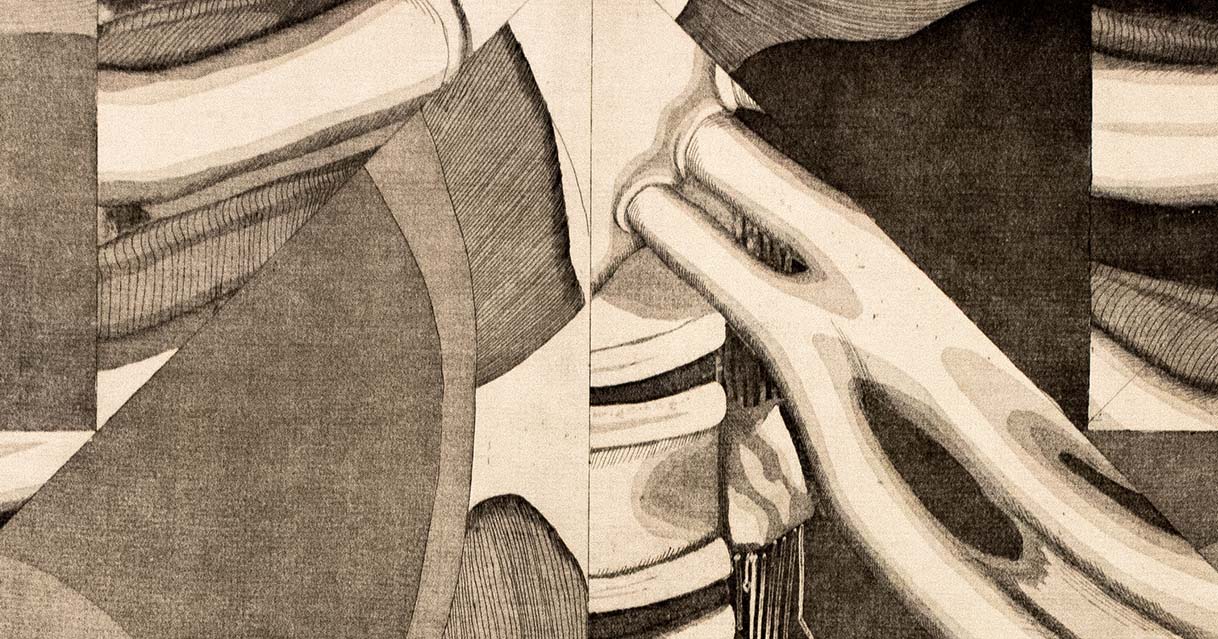
The Shape of Carrying is an expansive nine panel artwork on paper by Michelle Kwasnycia. It was created in 2026 using a printing technique called etching alongside ink on coloured paper. It is located outside the McMullen Gallery in a recessed window space.
The artwork is hung flat to the wall, six sections of paper that together measure six by six feet. The work is composed of geometric shapes, triangles with thick black borders that outline areas featuring flat planes of colour, patterns, and drawings. The triangular shapes create an alternating grid where more complexly patterned or detailed areas are placed next to or are intersected by blocks of colour. This pattern references a quilt, where sections of designs and images have been joined together with others, so that some may appear out of place or disconnected from the surrounding images.
In the centre of the work, stretching from top to bottom is the shape of a body. It takes up the majority of the composition, with the top edge of the print beginning just above the body’s mouth and the bottom ending just below their hips. The body is geometrically sectioned into pieces by the work’s alternating triangles. Some sections are detailed with long red parallel lines articulating the colour and shape of muscles, others feature bright white bones on a black background, and a few articulate pale body parts outlined with black lines. The body’s shoulders feature intricate drawings of flowers, chrysanthemums with skinny petals tattooed in blue and red.
Through its assembled pieces, the work reveals and then obscures layers of skin, flesh, muscle, and bone, alternating between them to create views of a body that shift and change. It’s a composition that’s almost like a puzzle, but the pieces are all out of order or arranged in a way where they don’t quite connect. Around the outline of the body, the triangular shapes feature patterns in shades of red, blue, and green intersected by flat planes of gold, off-white, and creamy yellow. These patterned sections at times reference shapes familiar to Smartwear, the zigzagging lines of a sensor, the weave of a textile, the long spindly lines of a computer chip.
About the artwork and artist:
The Shape of Carrying was created during the artist’s summer research practicum with Smartwear and is inspired by their experiences. During her practicum, Michelle encountered mothers whose experiences shaped her understanding of the body as both extraordinarily individual and individually extraordinary.
The artwork’s panels illustrate a postpartum trunk with skeletal and muscular systems articulated through patterns that are inspired by quilting. By using the visual language of the textile practice of quilting, the artist embeds a generational familial care tradition that tenderly sections and intertwines the body’s structures. The pattern’s motifs reference forms observed in Smartwear’s interdisciplinary laboratory environments, connecting textile processes with anatomical research and scientific inquiry.
Through the work, imagined, largely unseen, and extraordinary interior spaces of the body become something otherwise, each between and beyond tissues, technologies, and textiles. An extraordinary body reborn, The Shape of Carrying pays homage to mothers and the remarkable capacity of the body to carry, adapt, sustain, and transform life itself.
Michelle Kwasnycia is an interdisciplinary artist who specializes in painting and printmaking. Her work focuses on identity, culture, and presence in relation to aesthetic systems, exploring how visual language shapes and represents the bodymind amidst intersectional oppression. In 2026 Michelle was a Smartwear Revolution Summer Student and had the opportunity to spend four months as part of the team, visiting various labs and having conversations with researchers.