Overview
The Social Justice Working Group (SJWG) actively engages People with Lived Experience of injury and/or disability (PLEX) to co-design and co-develop Smartwear’s technology. Guided by disability and social justice principles and frameworks. Specifically, our working group has adopted the World Health Organization (WHO) WHO-GATE 5P Framework as a conceptual and practical framework to ensure this work is guided by social and disability justice principles, while remaining focused on human-centred design throughout the different phases of the project, from co-design to commercialization.
Working Group Overview
The World Health Organization (WHO) WHO-GATE 5P Framework was developed to be used as a strategy for strengthening access to assistive technology in any context. This strategy places “People” at the centre and focuses equal attention on: “Policy”, “Products”, “Provision” and “Personnel” as interconnected elements that must be aligned to ensure equitable access to any assistive technology that is newly developed.
Following this framework, our SJWG invites and supports the full participation PLEX within Smartwear. SJWG facilitates PLEX engagement through interviews and focus groups and supports the training of facilitators within TTWG and ADWG to join and actively engage PLEX in this work.
By foregrounding PLEX experiences to inform and co-create smart clothing designed to assist people with mobility limitations and to ensure that this work is guided by care for and responsiveness to their requirements, needs, concerns and wishes. PLEX involved in this project are persons with neuro-musculoskeletal weakness, including older adults; persons with muscular dystrophy, spinal cord injuries, or stroke; and persons at risk of injury at work, such as healthcare providers and home caregivers.
Our hope for this project is that this clothing will be easily accessible and available to all who may benefit from it. Specifically, our project is in the process of creating assistive technology that will be built into clothing to support trunk stability and add up to 30% arm and leg strength.
SJWG has three domains that continuously work to foster ongoing and generative engagement between researchers and PLEX, their communities, policy-makers and decision-makers within health care systems. SJWG three domains include:
PLEX Engagement, Social Justice in Design and Policy, and Health Care Systems Engagement.































Social Justice Working Group
Plex Engagement
This domain directly addressed the WHO Assistive Technology mandate of putting People at the center of the processes to design technology that could improve their lives. The PLEX Engagement domain is led by Dr. Adalberto Loyola-Sanchez . We have created a Community Advisory Board (CAB), formed by representatives of the three main groups of interest in this project (i.e., people with neuromuscular weakness, seniors and healthcare providers). The CAB functions through ongoing meetings and mainly operates through a consultation model, in which members CAB is critical for providing continuous feedback on all operations that involve engaging PLEX participants.
Also addressing the “Person” at the center of this approach dictated by the WHO Assistive Technology Framework, the core commitment that guides our work, is ensuring that Smartwear is developed through a true co-design process that centres the knowledge, experiences, and priorities of users. For us, co-design means collaborating meaningfully throughout the research and design process in a way that acknowledges and addresses power dynamics and honours CAB members’ time and expertise. Our meetings with CAB focus on centering PLEX participant experiences within the scope and objectives of the project. Within CAB meetings, we engage in deep discussions and consultations around how to work with PLEX in a respectful and dignified manner, and we seek preliminary guidance within the phases of technological development. We also intend to bring issues or potential challenges that we are facing in relation to PLEX engagement to CAB for guidance and advice.
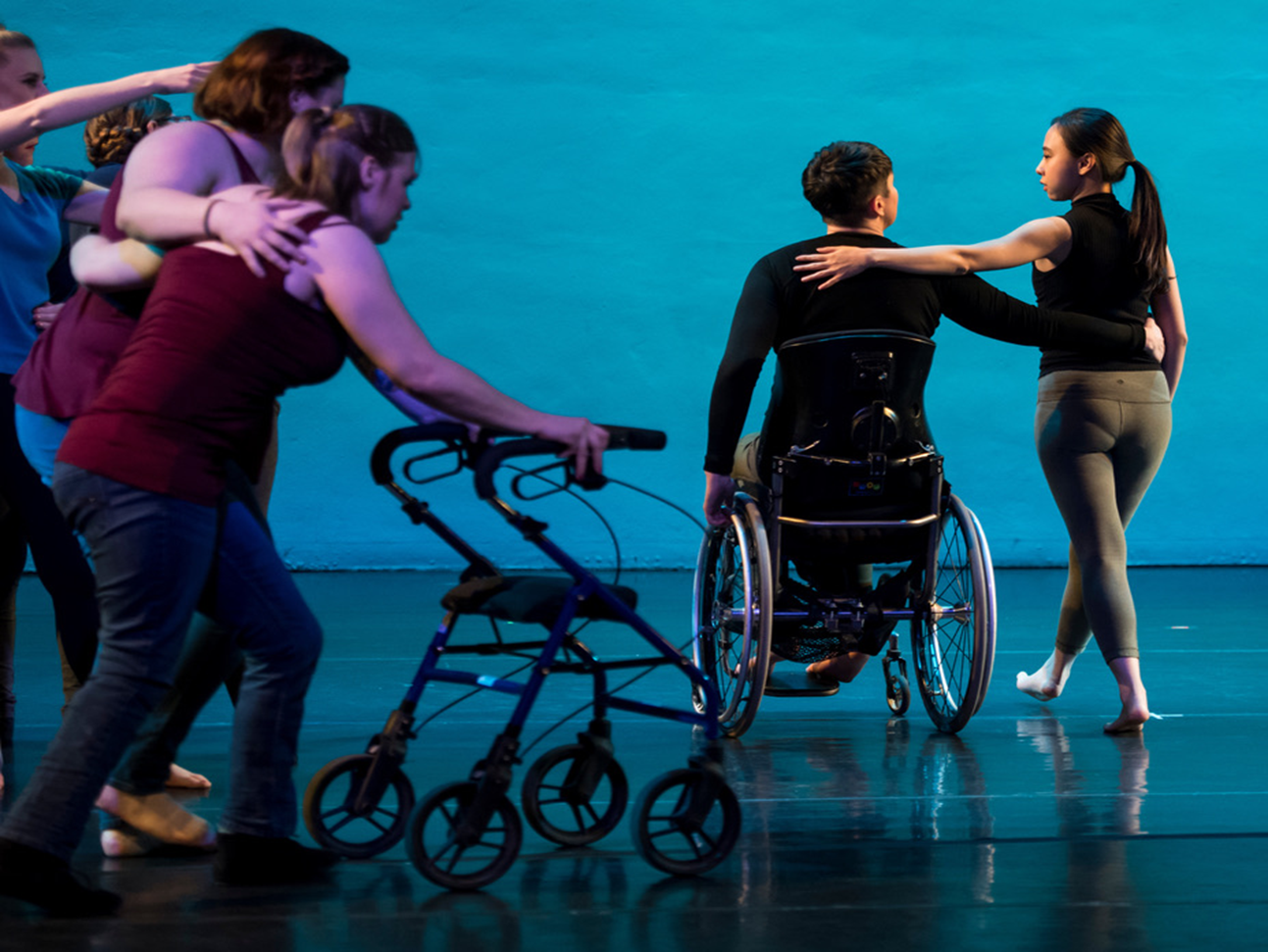
The image featured on the right is a stage performance choreographed by co-PI Lindsay Eales.
Social Justice Working Group Domain
Social Justice in Design & Policy
This domain critically addresses the WHO Assistive Technology approach, the policies and approaches that may foster the accessibility of new assistive technology, and the opportunities and constraints of the UN declaration of human rights to health and wellbeing for all, including people with disabilities.
The Social Justice in Design and Policy Domain is led by Dr. Reisa Klein, Dr. Yasmeen Abu-Laban, Dr. Michael Orsini and Dr. Danielle Peers. The Social Justice in Design and Policy domain fosters transdisciplinary debate, knowledge production and policy recommendations, underpinned by a critical disability studies and an intersectional lens. Through workshops, dialogues and symposiums, we invite team members, community and interest holders to co-learn and reflect on critical themes from crip tech, to community accessibility, to dual use, all with the goal of meaningfully advancing the social justice underpinnings of this project.
We will also host a policy summit that will bring together policy experts, researchers, community leaders, health regulators and industry to develop common priorities and actionable and appropriate strategies for regulatory intervention.

Social Justice Working Group Domain
Health Care Systems Engagement
Finally, our Health Care Systems Engagement domain directly addresses the WHO Assistive Technology mandate of always considering the “Provision” and required “Personnel” aspects when developing assistive technology. This domain is co-led by Dr. Verna Yiu and Dr. Chester Ho. A primary focus of this domain is to engage and consult with community partners and organizations within health care systems to foster dialogue and understanding about our assistive technology. These efforts will help us understand how our assistive technology can be successfully implemented within different health care ecosystems. Therefore, we consider it essential to engage with health care systems’ representatives to better understand their requirements, specifications, and barriers to uptake and implement our assistive technology.
Our engagement strategy with the Health Care Systems Engagement will inform the work conducted by the Smartwear the Textile and Technology Working Group (TTWG) and the Art and Design Working Group (ADWG) to allow responsive adaptation of Smartwear Revolution “Product” development in the nascent stages of design.
Dr. Chester Ho and Dr. Chris McCabe will also work within the area of Health Economics to explore how to best optimize health care opportunities by using our smartwear as a resource to foster sustainable, equitable and accessible assistive technology within health care systems.